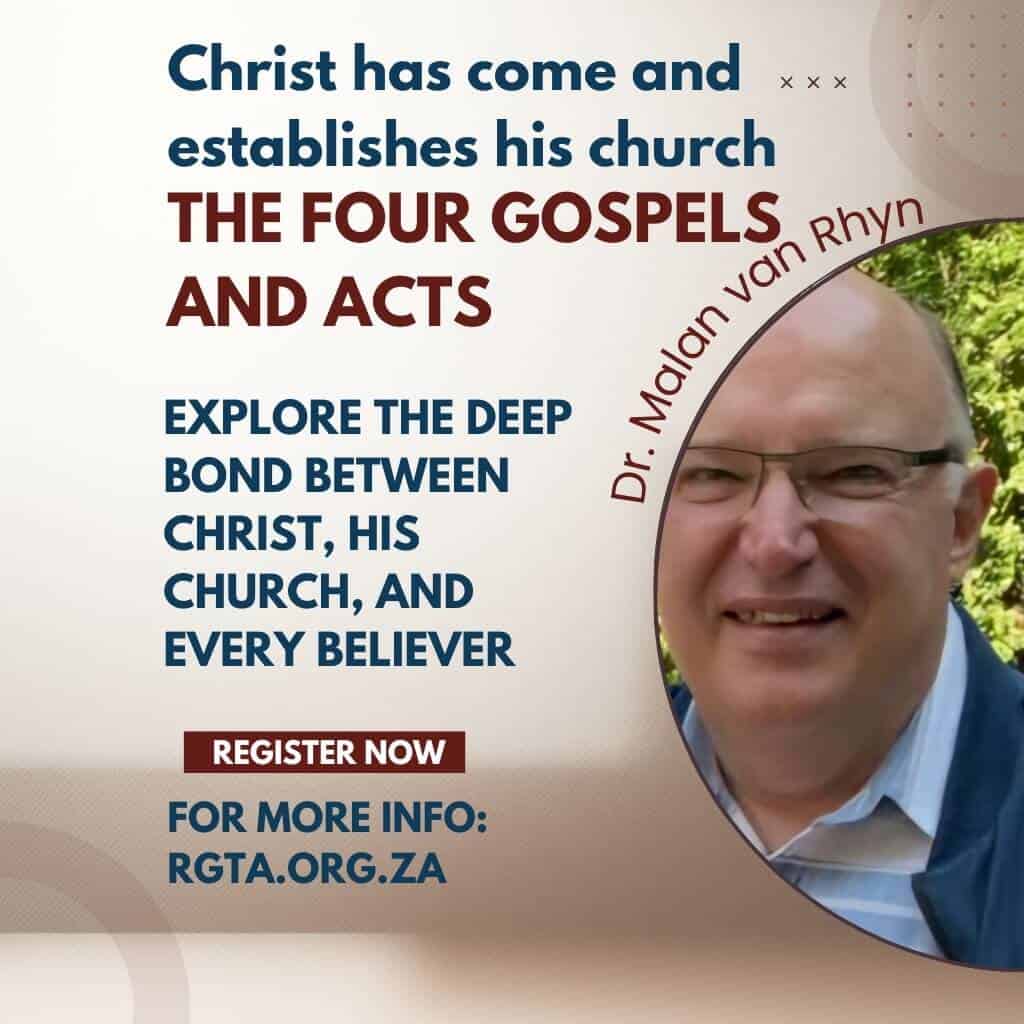
The four Gospels and Acts [Next intake 2027]
Explore Christ's life, death, and resurrection as Old Testament fulfilment and the inauguration of God's new covenant. Trace the Holy Spirit's work in establishing the early church in Acts.
THE FOUR GOSPELS AND ACTS: Christ has come, and establishes his church
This course provides a comprehensive study of the Synoptic Gospels (Matthew, Mark, and Luke) and the book of Acts. Students will examine the life, ministry, death, and resurrection of Jesus Christ as the fulfilment of the Old Testament promise and the inauguration of the new dispensation.
The course will also trace the ongoing work of Christ through the Holy Spirit in the early church, as recorded in Acts.
These five books reveal God’s grace, the uniqueness of Christ, and establish a special relationship between God and every believer. They affirm and explore the inseparable bond between Christ and His church, as well as the integral communion of every believer with the body of Christ.
Believers gain a deeper understanding of what a relationship with God entails and His purpose for their lives. The course also examines key themes such as the Kingdom of God, the Covenant and its sign through baptism, the commission to evangelise, and in particular, the work and ministry of the Holy Spirit.
Presented by:
Dr Malan van Rhyn
second semester roster

In Their Own Words



0 Reviews
Unable to load reviews. Please try again later.
No reviews yet. Be the first to write a review!
Related Products
![Canons of the Bible - Textual Criticism [Next intake 2027]](http://rgta.org.za/wp-content/uploads/2025/12/textual-criticism.jpg)
Canons of the Bible - Textual Criticism [Next intake 2027]
Discover how the Bible you hold was faithfully preserved through centuries—and learn to defend Scripture's authority with confidence through textual criticism and translation principles.
![Catechetics [Next intake 2027]](http://rgta.org.za/wp-content/uploads/2025/12/catechetics.jpg)
Catechetics [Next intake 2027]
Fulfil Christ's Great Commission by mastering effective teaching principles. Equip yourself to create healthy learning environments and guide children, young people, and adults toward spiritual maturity, helping others understand, apply, and defend their faith.
![Christ and Worldviews [Next intake 2027]](http://rgta.org.za/wp-content/uploads/2025/12/christ-and-wordviews.jpg)
Christ and Worldviews [Next intake 2027]
Equip yourself to proclaim the Gospel effectively by understanding how people think. Examine influential worldviews—including Judaism, Islam, African worldviews, existentialism, and postmodernism—then develop a grounded Christian worldview you can live out and defend in society.
![Church Goverment Systems [Next intake 2027]](http://rgta.org.za/wp-content/uploads/2025/12/church-goverment-systems.jpg)
Church Goverment Systems [Next intake 2027]
Discover how Christ governs His church through biblical principles expressed in Reformed church government. Compare various systems while exploring the roles of ministers, elders, deacons, and every church member in Christ's unique rule.
![Evangelistics [Next intake 2027]](https://rgta.org.za/wp-content/uploads/2026/06/church-growth-evangelistics-sem-2.jpeg)
Evangelistics [Next intake 2027]
Equip yourself to fulfil Christ's command: Make disciples. Learn to engage contemporary people with the Gospel, understand their hopes and fears, and build congregations that effectively welcome new believers.
![Exegesis [Next intake 2027]](http://rgta.org.za/wp-content/uploads/2025/12/exegesis.jpg)
Exegesis [Next intake 2027]
Master the art of biblical interpretation through careful engagement with Scripture's language, literary forms, and historical context. Learn to discern God's revelation responsibly, ensuring you hear His voice clearly rather than imposing personal preconceptions.
