The question deserves to be asked plainly: Is Reformed theology merely a preference among many Christian traditions, or is it a faithful reflection of what Scripture teaches?
At its heart, Reformed theology is convinced that sound doctrine matters. This is not a claim of superiority over other Christians, but a recognition that God has revealed Himself in His Word — and that the church is called to receive, preserve, and teach that truth faithfully.
The Apostle Paul expressed this concern when he instructed Timothy: “As I urged you when I was going to Macedonia, remain at Ephesus so that you may charge certain persons not to teach any different doctrine” (1 Timothy 1:3). The pursuit of doctrinal faithfulness is therefore not a uniquely Reformed concern — it is a biblical calling.
Reformed theology is often misunderstood. Some view it as simply one option among many — as though belonging to a Reformed church were a matter of personal taste, similar to preferring a particular style of music or worship. In this way, “Reformed” can be reduced to a label rather than a confession of deeply held biblical convictions.
Theologically and historically, however, the Reformed faith has understood itself differently. It is not defined by cultural preference or inherited tradition, but by convictions drawn from Scripture itself:
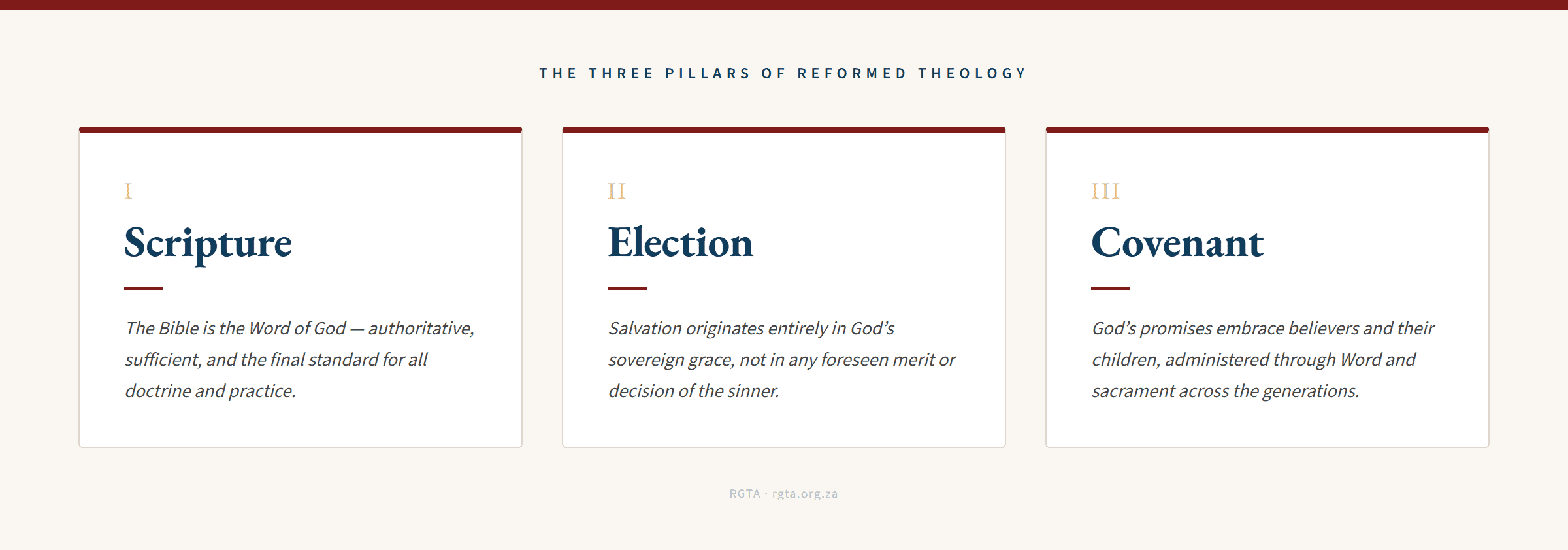
- The Bible is the inspired and authoritative Word of God
- Salvation is entirely the work of God’s sovereign grace
- God’s covenant provides the framework through which He gathers, preserves, and nurtures His people across the generations
These convictions shape not only what Reformed Christians believe, but also how they worship, teach, disciple, and serve within Christ’s church. This article explores the foundations of Reformed theology, what distinguishes it from other Christian traditions, and why its core teachings remain deeply relevant for every member of a Reformed congregation today.
The Three Biblical Pillars of Reformed Theology
Reformed theology rests on three foundational convictions — each drawn from Scripture, each distinguishing the Reformed tradition from other streams of Christianity.
These pillars do not stand in isolation. Together they form a coherent theological confession of who God is, how He saves, and how He relates to His people.
Pillar 1: The Bible is God’s Word
The first and most foundational conviction of Reformed theology is that the Bible is the Word of God in the fullest sense.
This means far more than that Scripture contains human reflections on divine realities. Reformed theology confesses that Holy Scripture is the very Word of God — authoritative, sufficient, trustworthy, and the final standard for all doctrine and practice.
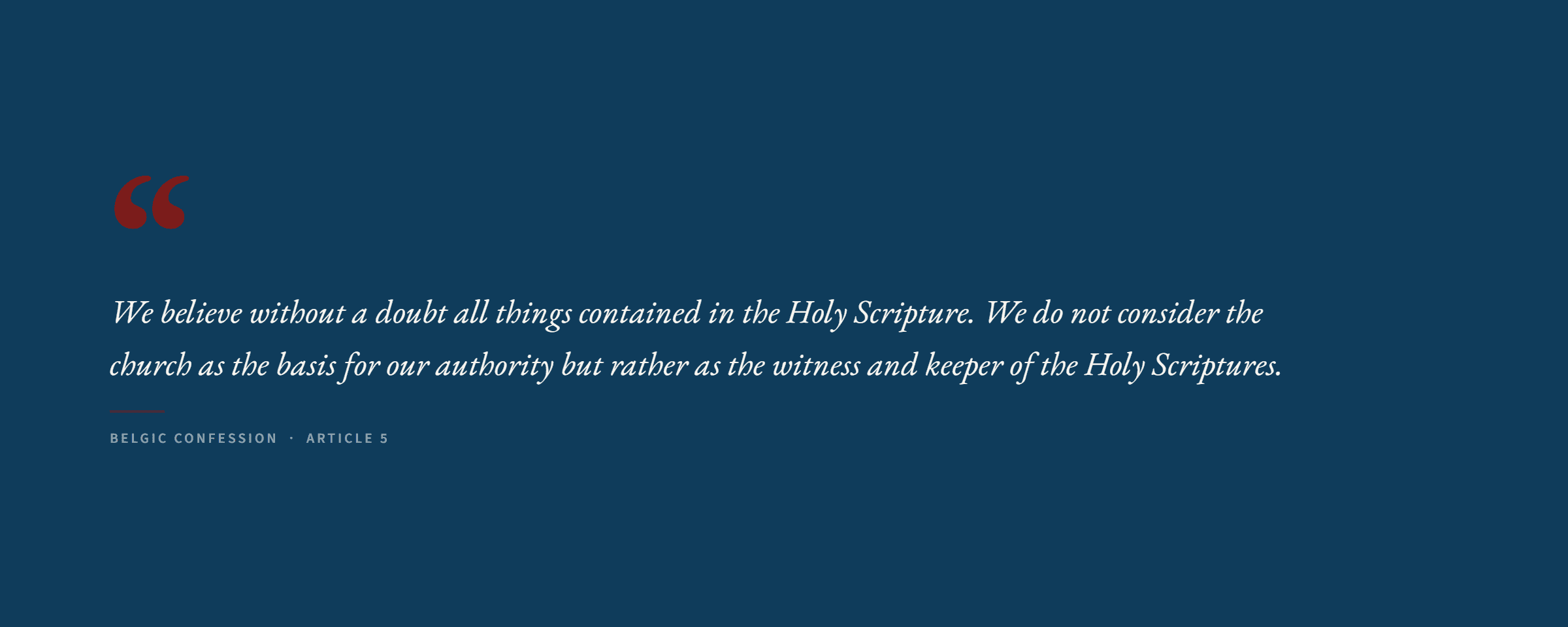
The Belgic Confession states this with clarity:
“We believe without a doubt all things contained in the Holy Scripture. We do not consider the church as the basis for our authority but rather as the witness and keeper of the Holy Scriptures.”
Scripture therefore stands above ecclesiastical tradition, church councils, synods, and the teaching of any individual minister. Wherever Scripture speaks, God himself speaks with divine authority.
What this looks like in practice
In Reformed preaching, the sermon is not primarily a reflection on the preacher’s personal experiences or an exploration of contemporary issues dressed in biblical language. It is the exposition and application of the biblical text — the congregation gathers to hear God address His people through His Word.
In catechetical instruction, the Heidelberg Catechism does not present human speculation or philosophical reasoning. It faithfully summarises biblical teaching on guilt, grace, and gratitude in a form accessible to believers of every age.
Scripture shapes every aspect of the church’s life: worship, sacraments, government, discipline, and the daily walk of the believer.
What Reformed theology rejects
Several alternative approaches to authority exist in the broader Christian world:
- Some traditions treat Scripture as one source among others, granting church tradition an equal or even superior role
- Others affirm that the Bible contains truths about God but maintain its historical or doctrinal claims may be revised in light of contemporary culture
- Still others approach Scripture primarily as a source of personal inspiration rather than authoritative divine revelation
Reformed theology rejects these alternatives — not as a denominational preference, but out of conviction that they fail to do justice to Scripture’s own testimony concerning its divine origin and authority.
For those seeking a deeper understanding of this foundational conviction, RTA’s courses on the Canon and Text of Scripture, as well as exegesis and hermeneutics, provide the tools necessary to read the Bible with both intellectual rigour and spiritual humility.
Pillar 2: The Doctrine of Election
The second pillar is the doctrine of election — and it is here that Reformed theology diverges most sharply from much of the broader evangelical world.
Election is the biblical teaching that, before the foundation of the world, God chose a people for Himself according to the good pleasure of His will — not on the basis of any foreseen merit, faith, or decision on their part.
This is not a doctrine invented by Reformed theologians for the sake of controversy. It arises from the plain teaching of Scripture. Passages such as Ephesians 1:4–5, Romans 8:29–30, and John 6:44 present salvation as originating in God’s sovereign initiative. As Christ himself declares: “No one can come to me unless the Father who sent me draws him.”
The Canons of Dort
The Reformed conviction concerning salvation is articulated with particular clarity in the Canons of Dort, adopted by the Synod of Dort (1618–1619), convened to address the theological challenges raised by the Remonstrants.
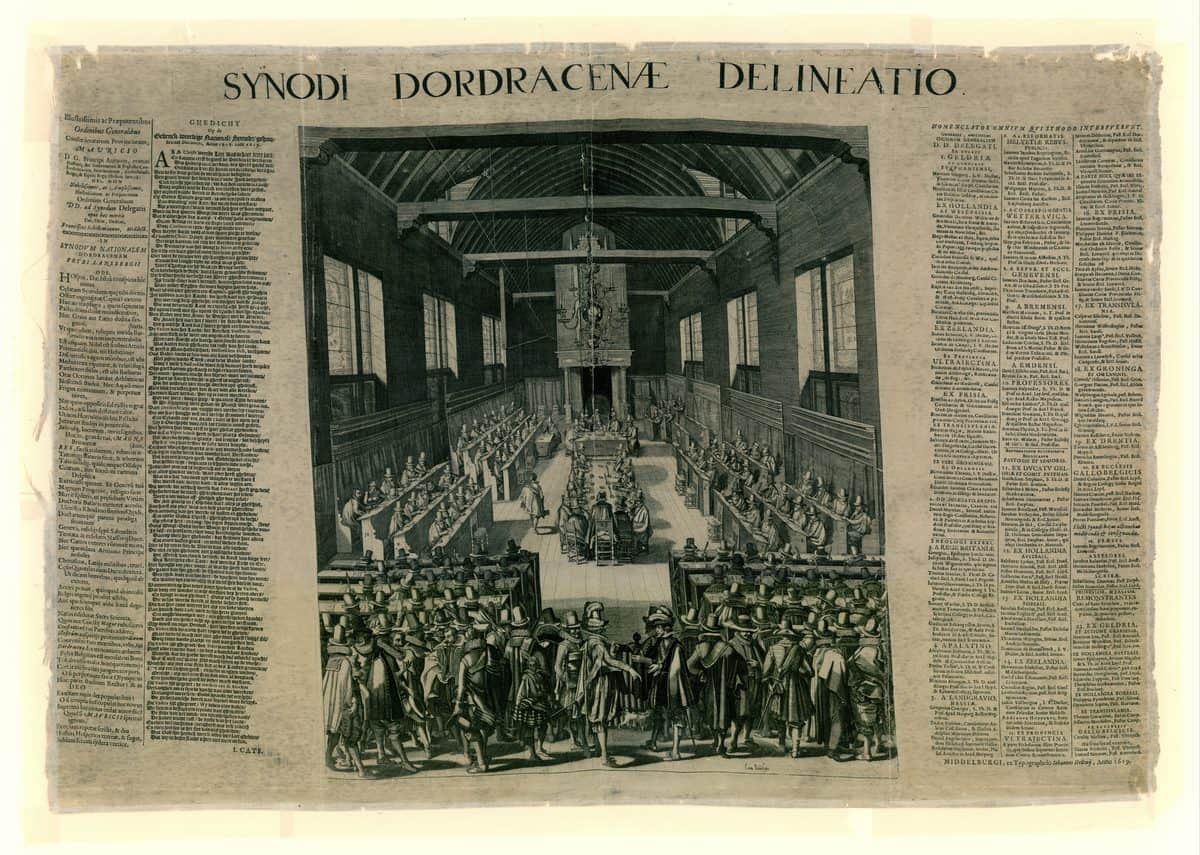
The Canons affirm a consistent principle throughout: salvation originates in God, is accomplished by God, is applied by God, and is preserved by God.
Scripture describes sinners as spiritually dead, incapable of raising themselves to new life. God, by His sovereign grace, regenerates the heart, grants faith, and effectually calls the sinner to Christ. The entire work of redemption — from beginning to end — is the work of God.
How this differs from Arminian theology
Much of contemporary evangelical Christianity operates within a broadly Arminian framework — God extends salvation to all and awaits their response, with the decisive moment resting in the individual’s choice to accept Christ. Expressions such as “accept Jesus into your heart” reflect this emphasis on human decision.
Reformed theology does not deny the reality of the human response. Faith is genuine, repentance is necessary, and the believer truly trusts in Christ. Yet faith itself is a gift of God’s grace — not a contribution from the sinner.
The decisive cause of salvation lies in God’s sovereign purpose, not the human will. As Paul writes: “Those whom he predestined he also called, and those whom he called he also justified, and those whom he justified he also glorified” (Romans 8:30). God does not begin the work of salvation only to leave its completion dependent upon human variability.
Election and the covenant
This doctrine is inseparably connected to the covenant. Election is not an abstract decree — it is God’s gracious determination to be the God of His people. Through the covenant of grace, God’s electing purpose is administered in history through the preaching of the Word and the sacraments, extending across generations according to His promise.
This leads naturally to the third pillar.
Pillar 3: Infant Baptism and the Covenant
The third pillar is the practice of infant baptism, understood within the framework of God’s covenant with His people.
Reformed theology teaches that the children of believing parents belong, by God’s sovereign grace, to the covenant community. The covenant of grace, established with Abraham and administered throughout redemptive history, embraces not only believers themselves but also their children.
As God declared to Abraham: “I will establish my covenant between me and you and your offspring after you throughout their generations, for an everlasting covenant” (Genesis 17:7).
The continuity of the covenant sign
In the Old Testament, circumcision served as the sign and seal of covenant membership — administered to male infants as members of God’s covenant people. In the New Testament, baptism succeeds circumcision as the covenant sign, administered to all members of the covenant community regardless of age or sex.
Infant baptism is therefore neither a dedication ceremony nor a symbolic expression of parental hope. It is the administration of the covenant sign to a covenant child. Through baptism, God publicly marks the child as belonging to the visible covenant community, declaring His promises and laying upon the child the obligations of covenant membership.
How this differs from Baptist theology
The Baptist and Anabaptist position holds that baptism must follow a conscious personal profession of faith. Because infants cannot make such a profession, infant baptism is regarded as invalid — and those baptised in infancy are often encouraged to be baptised again upon personal confession.
Reformed theology rejects this position on both exegetical and theological grounds. The coming of Christ did not narrow the covenant — it expanded it and brought it to greater fullness. The promise given to Abraham was never restricted to individual believers; it always included their descendants.
What this means for church life
The children of believers are regarded as holy — set apart by God’s covenant commitment. They are members of the visible church and beneficiaries of its ministry from the earliest days of life.
As they mature, they are called to embrace by faith the promises signified in their baptism and to fulfil the obligations of the covenant. This conviction shapes the Reformed approach to family life and church ministry: Christian education, catechesis, family worship, and the pastoral care of covenant children are all directed toward nurturing covenant members in the knowledge of God and the obedience of faith.
How These Three Pillars Shape Reformed Life
These three convictions — Scripture’s authority, God’s sovereign grace in election, and the covenant sign of baptism — are not isolated doctrines. They shape and permeate the entire practice of Reformed Christianity.
Preaching is firmly grounded in Scripture. The minister’s task is to explain the biblical text and apply God’s will to the life of the congregation. The message arises from the text itself — not from topical themes that use Scripture to support a predetermined point.
The sacraments are administered as covenant acts. The Lord’s Supper is more than a memorial; it is a means of grace through which Christ nourishes believers and confirms His promises to His church. Baptism is not a personal achievement, but a divine promise and covenant sign. Both belong to the covenant community and are administered under the oversight of the church.
Church discipline reflects the concern for doctrinal faithfulness and moral integrity that flows from these foundational convictions. The congregation is a covenant community whose members bear real privileges and responsibilities. When a member abandons the faith or persists in conduct that contradicts their profession, the elders bear responsibility for that person’s spiritual welfare. Exercised with patience, humility, and love, discipline is a pastoral ministry aimed at repentance and restoration — not institutional control.
Church governance reflects mutual accountability under Christ. No individual — whether minister, elder, synod, or even the denomination itself — possesses authority above the Word of God. Scripture alone remains the final rule for the faith and life of the church.
The Reformed Theological Academy
The Reformed Theological Academy is unapologetically Reformed in its theological convictions. Its commitment to the Three Forms of Unity — the Belgic Confession, the Heidelberg Catechism, and the Canons of Dort — reflects a principled dedication to the historic teachings of the Reformed faith.
Established under the oversight and mandate of the GKSA, the Academy exists to provide sound theological training for church members, elders, deacons, and those considering future service in ministry.
For many generations, advanced theological training was largely reserved for those preparing for full-time ministry. The RTA opens that opportunity to a much wider audience.
What the Academy offers:
- Biblical Studies, Reformed theology, hermeneutics, and catechetics
- Church polity, exegesis, and a range of other theological disciplines
- Evening courses — structured for students with work, family, and congregational responsibilities
- All courses offered in both Afrikaans and English
Whether you are seeking to deepen your understanding of Scripture, strengthen your grasp of Reformed doctrine, or better serve those entrusted to your care, theological growth begins with purposeful study. Knowing what you believe, why you believe it, and how to communicate those truths clearly and faithfully is a lifelong privilege and responsibility.
Explore the RTA course offerings →
Conclusion
Reformed theology is not simply a tradition inherited by chance or embraced out of habit. It is a rich and carefully considered belief about God, His Word, and His grace — shaped by Scripture and reflected in every aspect of the church’s life, from worship and teaching to pastoral care, discipleship, and service.
The question this article set out to answer was simple: What is Reformed theology?
The answer offered by the Reformed tradition is both clear and compelling: it seeks to express what the Bible teaches. This was the conviction of the Reformers in the sixteenth century, and it remains the conviction of the RTA today.
The confidence of the Reformed tradition ultimately rests not in the history of the Reformed churches, the reputation of the RTA, or the gifts of any individual theologian. Its foundation is the Word of God itself. There, in the Scriptures, Reformed theology finds its source, its authority, and its continual renewal.
Every meaningful study of Reformed theology begins with God’s Word — and continually returns to it, seeking ever deeper understanding, faith, and obedience.
Begin your study — explore the RTA course offerings →
The Reformed Theological Academy (RTA) provides enriching evening courses in Reformed theology for congregation members, office-bearers, and those considering a future in ministry. While the Academy serves the GKSA community, participation is open to everyone with an interest in Reformed theology. Courses are offered in both Afrikaans and English.